



VII. Gases

Key focus of this chapter: ideal gas law

This chapter focuses on the ideal gas law and gives concise summaries of the important things about speed of gases, Dalton’s law of partial pressures, and gas stoichiometry in more detail.

A. Temperature

1. Fahrenheit and Celsius

2. Kelvin and Celsius

B. Gas Theory

1. Kinetic molecular theory (ideal gases)

Gas particles have no intermolecular attractions or repulsions in the ideal-gas model.

Gas particles move continuously in random, straight-line motion between collisions.

The volume of individual gas particles is negligible compared with the volume of the container.

Collisions between gas particles and with the container walls are perfectly elastic.

The average kinetic energy of gas particles is directly proportional to the absolute temperature (K).

2. Real gases

Real gases do not always behave ideally.

Deviations from ideal behavior are greatest at high pressure and low temperature because

intermolecular attractions and the finite volume of gas particles become significant.

The van der Waals equation accounts for intermolecular attractions and molecular volume and better describes real gases.

C. Gas Laws

1. Symbols of gas laws

P: Pressure   (Pi = initial pressure, Pf = final pressure)

Use absolute pressure in all gas-law equations. If a gauge pressure is given, P_abs = P_gauge + P_atm. Use pressure and volume units consistent with R.

V: Volume    (Vi = initial volume, Vf = final volume)

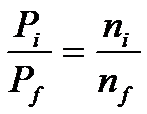
n: Number of moles (ni = initial moles, nf = final moles)

R: Gas constant

T: Temperature (Kelvin, K) (Ti = initial temperature, Tf = final temperature)

2. STP (Standard Temperature and Pressure)

T = 273.15 K (0 °C)

P = 1 atm (760 mmHg)

R = 0.08206 L•atm/(mol•K)

In this chapter, STP means 273.15 K and 1 atm. At these conditions, 1 mol of an ideal gas occupies approximately 22.4 L (V_m = RT/P).

A 1 bar (100 kPa) STP convention instead gives approximately 22.7 L/mol at 273.15 K. Use the stated pressure convention; 22.4 L/mol does not apply at arbitrary T and P.

3. Ideal Gas Laws

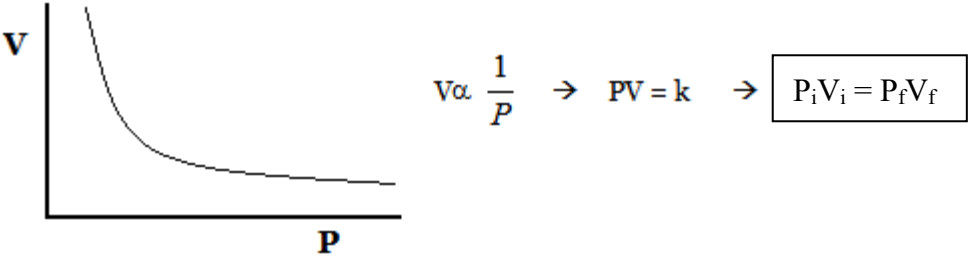
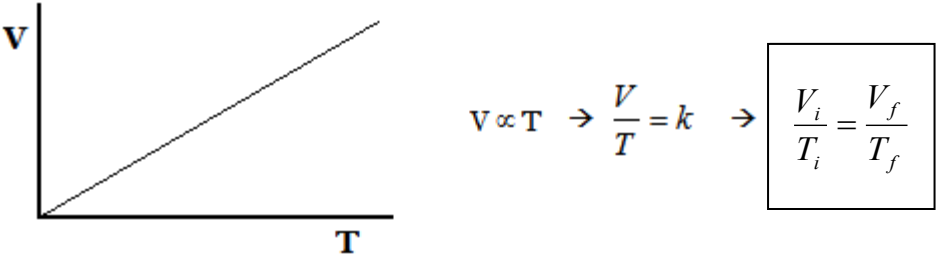
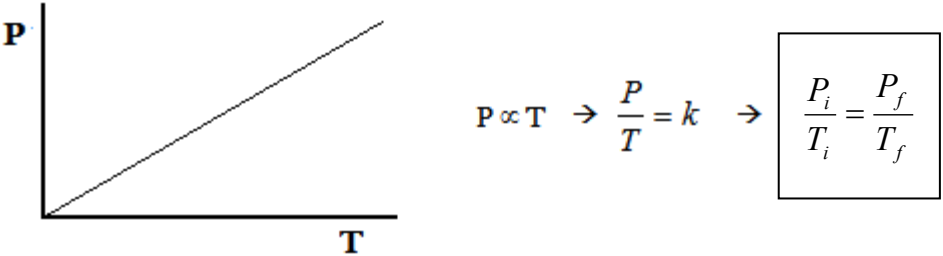
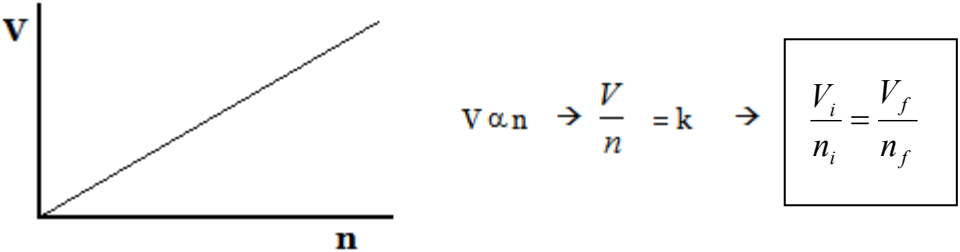
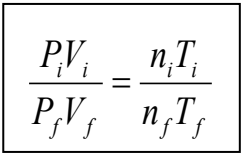
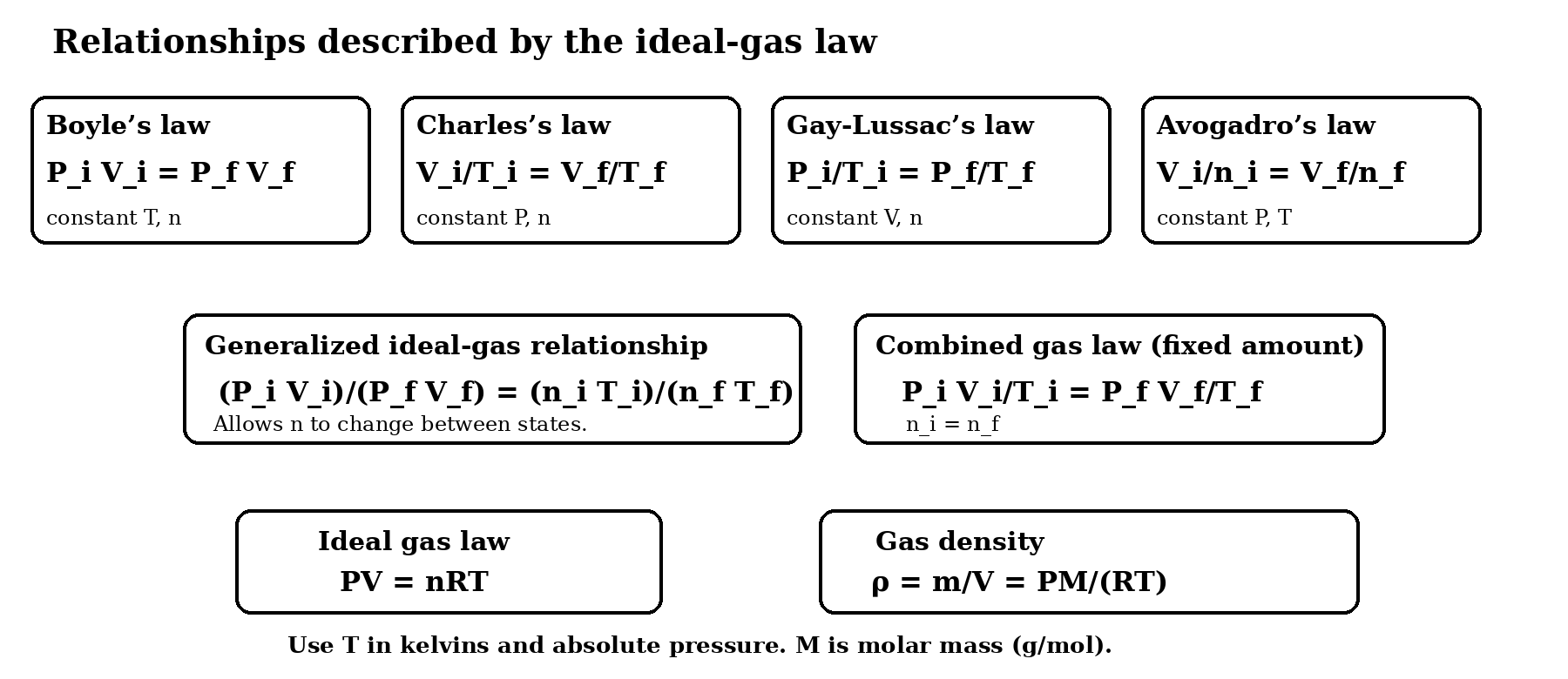
4. Relationships described by ideal gas law

D. Speed of Gases

1. Diffusion: spontaneous mixing of gas particles as a result of their random molecular motion.

2. Effusion: movement of gas particles through a very small opening from a container into a

vacuum or lower-pressure region.

3. Grahams Law: the rate of effusion is inversely proportional to the square root of the gas molar mass.

Graham’s Law can be used to compare the effusion rates of two gases.

Heavier gas molecules effuse more slowly than lighter gas molecules at the same temperature.

Rate ∝ 1/√M;  r₁/r₂ = √(M₂/M₁)

Compare effusion rates at the same temperature and upstream pressure through the same molecular-effusion aperture, with negligible downstream pressure. M is molar mass.

E. Daltons Law of Partial Pressures

1. Daltons Law

: The total pressure of a mixture of nonreacting gases equals the sum of the partial pressures

of the individual gases.

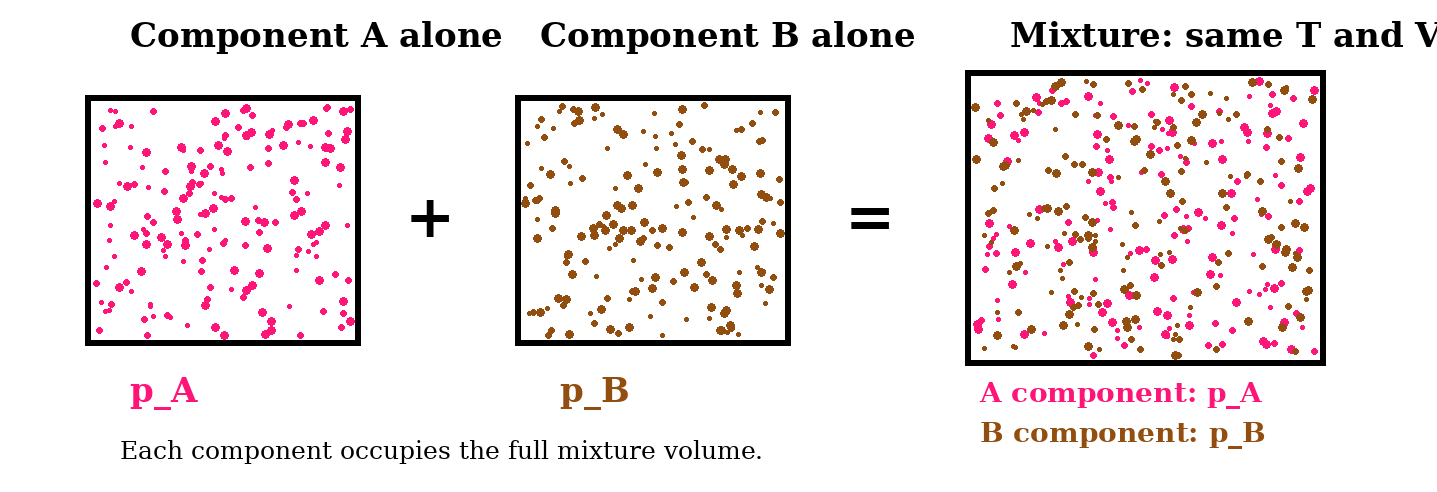
For an ideal-gas mixture (a good approximation for sufficiently dilute real gases), P_total = Σp_j. Each partial pressure is the pressure that component would exert alone at the mixture's temperature and full volume.

Ptotal  = PA + PB

Authenticated embedded content preview

2. Partial pressure and volume

: When nonreacting gases initially confined to separate volumes are allowed to mix in a sealed, rigid system at the same constant temperature, each gas expands to the final accessible volume.

After equilibration, both components occupy V_total. Neglect the connecting-tube volume, so V_total = V_A + V_B.

  Authenticated embedded content preview 

PA                             PB                  Partial PA                      Partial PB                                            

VA              +               VB             =                  Vtotal

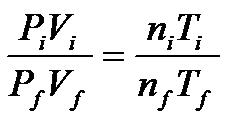
Authenticated embedded content preview  Source symbol Wingdings F0E0  Authenticated embedded content preview  Source symbol Wingdings F0E0  PiVi = PfV

         Partial pressure of  g as A:

PiVi = PfVf   Source symbol Wingdings F0E0  PAVA
=
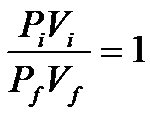
Partial PA•Vtotal   Source symbol Wingdings F0E0   Authenticated embedded content preview

        Partial pressure of  g as B :

PiVi = PfVf   Source symbol Wingdings F0E0  PBVB
=
Partial PB•Vtotal   Source symbol Wingdings F0E0   Authenticated embedded content preview

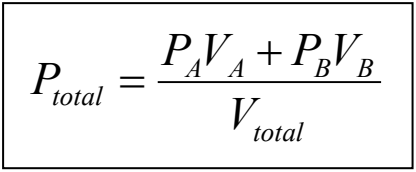
Total pressure at opened valve:  

Ptotal = Partial PA + Partial PB

= Authenticated embedded content preview + Authenticated embedded content preview

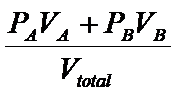
= Authenticated embedded content preview

3. Mole fraction, X:

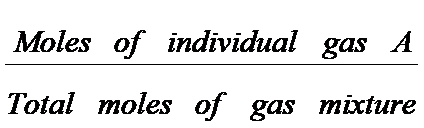
Fraction of the total moles in a gas mixture contributed by an individual gas

Equal to the moles of the individual gas divided by the total moles in the mixture

XA = Authenticated embedded content preview 
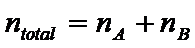
= Authenticated embedded content preview       (Authenticated embedded content preview)

4. Partial pressure and mole fraction

: The partial pressure of gas A in a mixture equals its mole fraction (XA) multiplied by the

total pressure of the gas mixture.

Authenticated embedded content preview Source symbol Wingdings F0E0  Authenticated embedded content preview Source symbol Wingdings F0E0  Authenticated embedded content preview Source symbol Wingdings F0E0 Authenticated embedded content preview Source symbol Wingdings F0E0  PA = XA • Ptotal

For an ideal-gas mixture at common T and V: p_A = n_A RT/V and P_total = n_total RT/V; therefore p_A/P_total = n_A/n_total = X_A.

Application — gas collected over water: P_dry gas = P_total − P_H₂O(T). Use the saturated water-vapor pressure at T. If water levels differ, account for the hydrostatic pressure difference before treating the gas pressure as atmospheric.

F. Gas Stoichiometry

: The ideal gas law (PV = nRT) can be applied to gas stoichiometry.

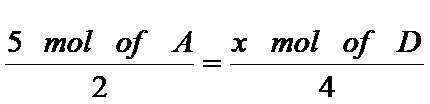
Q/ Given 2A(g) + B(g) → 3C(g) + 4D(g), 5.0 mol of A reacts completely with excess B.

The product D is collected separately in a 6.0 L container at 27 °C. Assuming ideal-gas behavior, calculate the pressure of D.

2A(g) + B(g)  Source symbol Wingdings F0E0  3C(g) + 4D(g) 

Sol/ Moles of D:

       Authenticated embedded content preview  

n_D = 10 mol D

Temperature: T = 27 + 273.15 = 300.15 K (approximately 300 K).

Pressure:

Rearrange the ideal gas law, PV = nRT, to solve for pressure:

P_D = n_DRT/V
= [(1.0 × 10¹ mol)(0.08206 L·atm·mol⁻¹·K⁻¹)(300.15 K)]/(6.0 L)
≈ 41 atm