V. Thermochemistry
Key focus of this chapter: enthalpy change
This chapter focuses on enthalpy change and gives concise summaries of the important things about energy, work by pressure, heat energy, Hess’s law, and entropy change in more detail.
Thermochemistry: The study of heat absorbed or released during chemical reactions.
A. Energy (E)
: The capacity to do work (W) or transfer heat (Q).
ΔE (change in energy) = Efinal – Einitial
|
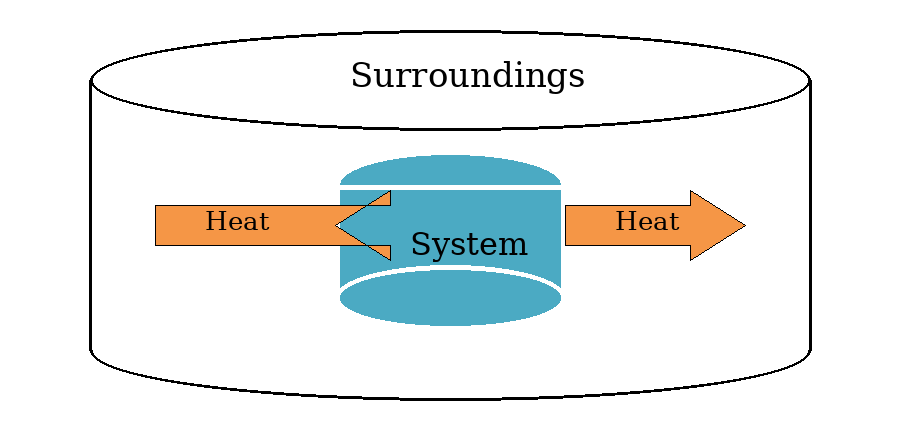
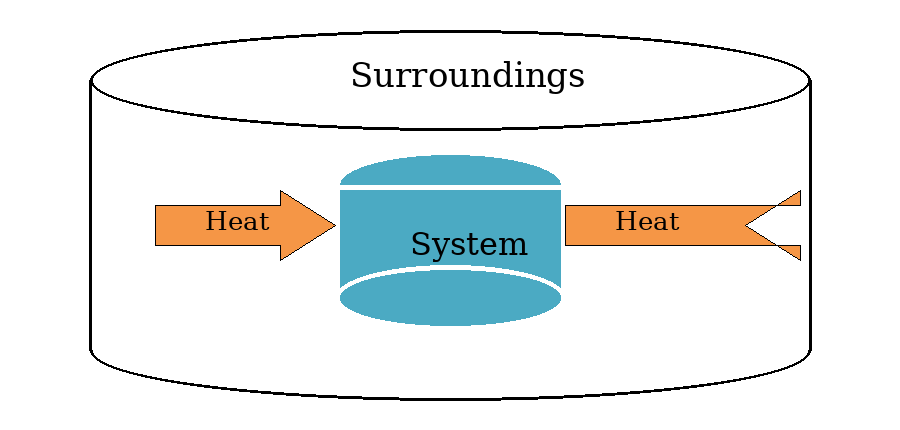
ΔE = W + Q W: work Q: heat |
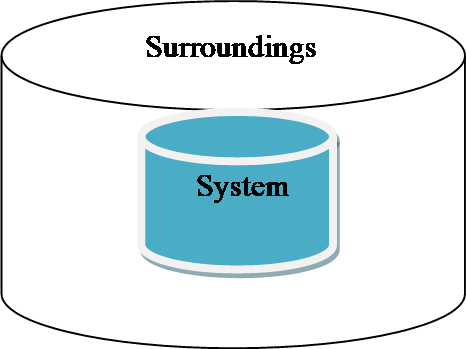
• System: the part of the universe being studied (reactants and products).
• Surroundings: everything outside the system.
|
• Qs/ What is ΔE when the system does 100 J of work and releases 80 J of heat?
ΔE = W + Q
= (-100 J) + (-80 J)
= -180 J
B. Pressure-volume work
1. Pressure
|
P = P: pressure (Pa), F: force (N), A: area (m2) |
• 1 atm = 760 mmHg (torr)
2. Work (W)
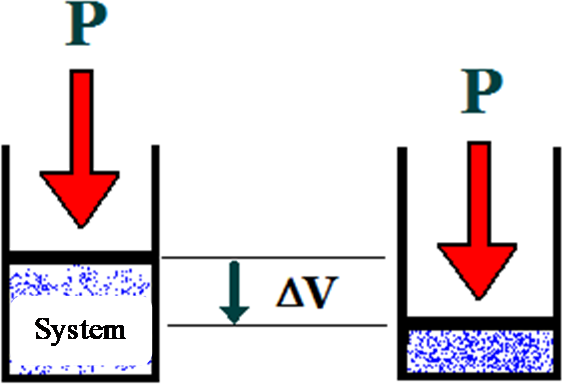
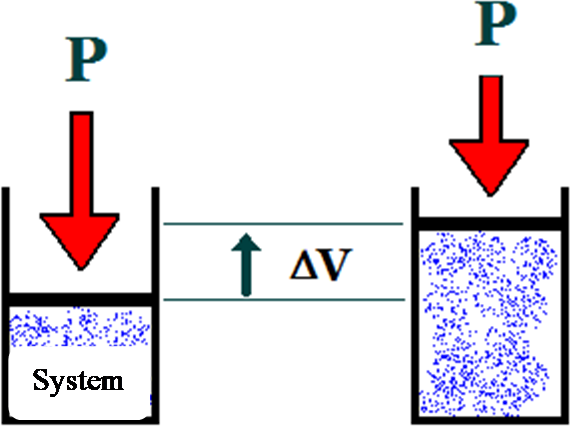
: Work associated with a pressure-volume change.
|
W = -Pext ΔV Pext: external pressure ΔV = Vfinal – Vinitial |
|
• Qs/ What is the work when the volume expands from 8.0 L to 10.0 L against an external
pressure of 3.0 atm?
W = -Pext ΔV (work is done by the system)
= -(3.0 atm)(10.0 - 8.0 L)
= -6.0 L·atm
C. Heat energy, Q
|
Q = C·m·ΔT C: specific heat capacity m: mass of substance (g) ΔT: temperature change |
• Calorie: the heat required to raise the temperature of 1 g of water by 1 °C.
** 1 cal = 4.184 J
• Specific heat, C: the heat required to raise the temperature of 1 g of a substance by 1 °C.
|
C = |
** Specific heat of water is 4.18 J/(g·°C).
• Qs/ Calculate the heat required to raise the temperature of 100 g of water from 50 °C to 80 °C.
Q = C·m·ΔT
= 4.18 J/(g·°C) × 100 g × (80 - 50) °C
= 12,540 J
• Qs/ Calculate the specific heat of gold when 650 J of heat raises the temperature of
50 g of gold from 25 °C to 125 °C.
C = ![]()
= ![]()
= 0.13 J/(g·°C)
D. Laws of thermodynamics
|
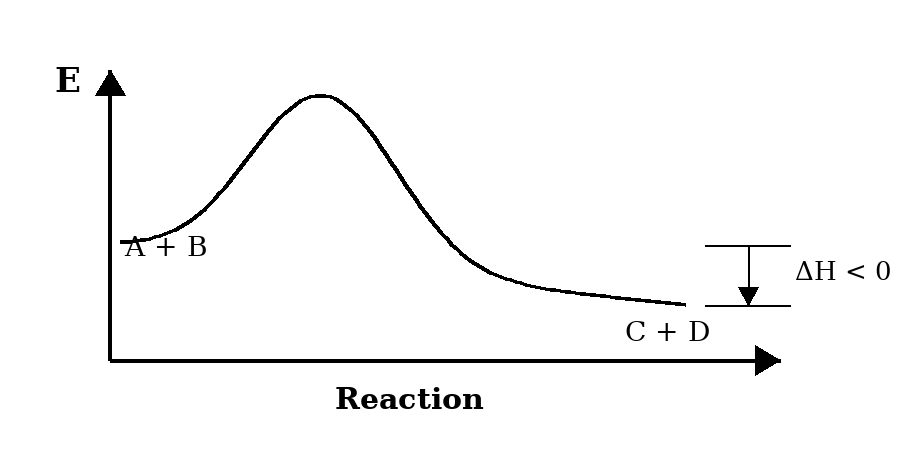
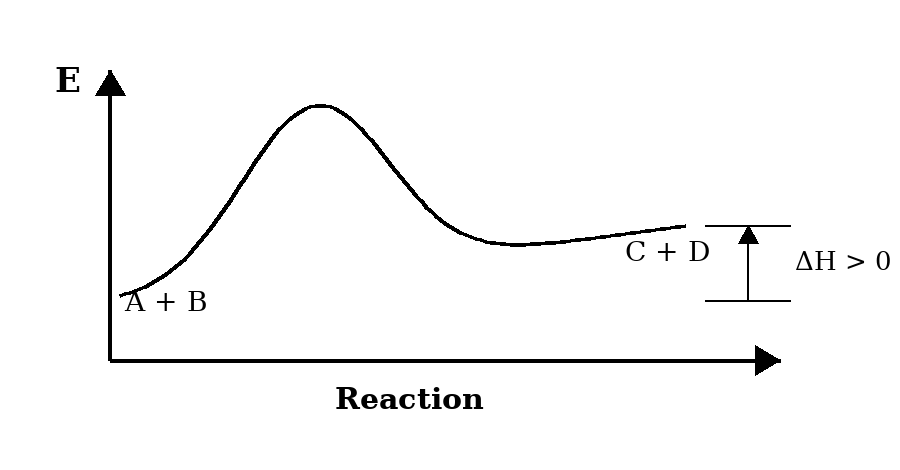
E. Enthalpy change, ΔH
: ΔH = Hfinal – Hinitial
|
** The total energy of the system plus surroundings is conserved in both exothermic and endothermic processes.
F. Hess’s Law
• The ΔH of an overall reaction equals the sum of the ΔH values for the individual steps.
• Enthalpy is a state function, so the enthalpy change depends only on the initial and final states,
not on the reaction pathway.
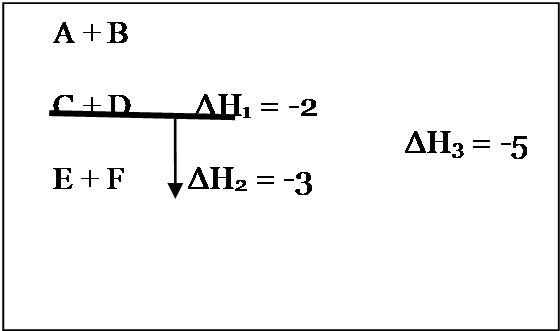
A + B → C + D, ΔH1 = -2 ——– (1)
C + D → E + F, ΔH2 = -3 ——– (2)
—————————————————–
A + B → E + F, ΔH3 = -5 ——– (3)
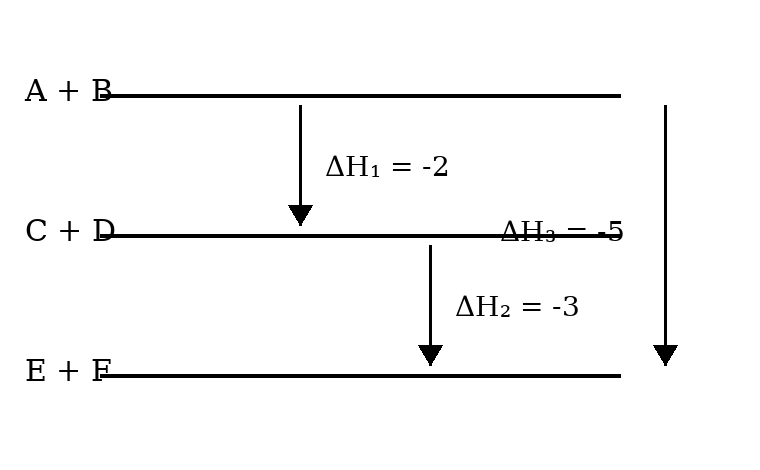
By Hess’s law: (1) + (2) = (3); therefore ΔH1 = ΔH3 – ΔH2.
• Qs/ Calculate the enthalpy change, ΔH, for the reaction S(s) + O2(g) → SO2(g) from the
following information.

|
Sol)
|
Therefore, the enthalpy change for S(s) + O2(g) → SO2(g) is +5 kJ/mol.
G. Determining enthalpy changes, ΔH°
: Ways to determine ΔH° for chemical reactions.
|
Qs/ Calculate ΔH°rxn for the reaction.
CH4(g) + 2O2(g) → CO2(g) + 2H2O(l)
|
Sol) ΔH°rxn = ΣνΔH°f(products) - ΣνΔH°f(reactants)
= [CO2 + 2H2O] - [CH4] ** ΔH°f of O2(g) = 0 kJ/mol
= [(-390) + 2(-290)] – (-75)
= -895 kJ
Qs/ Estimate ΔH for the reaction using the average bond dissociation energies in Table B.
2C2H6(g) + 7O2(g) → 4CO2(g) + 6H2O(g)
| ||||||||||||||
Sol) Σ(bond energies of bonds broken) - Σ(bond energies of bonds formed)
= [(C-H)×12 + (C-C)×2 + (O=O)×7] - [(C=O)×8 + (O-H)×12]
= [410×12 + 350×2 + 500×7] - [730×8 + 460×12]
≈ -2,240 kJ
H. Entropy change, ΔS

|
Entropy change (ΔS) |
|
• ΔS = Σ(entropy of products) - Σ(entropy of reactants)
Qs/ Calculate ΔS.
W + X → Y + Z
|
ΔS = (Y + Z) - (W + X)
= (5 + 4) - (3 + 2)
= 4
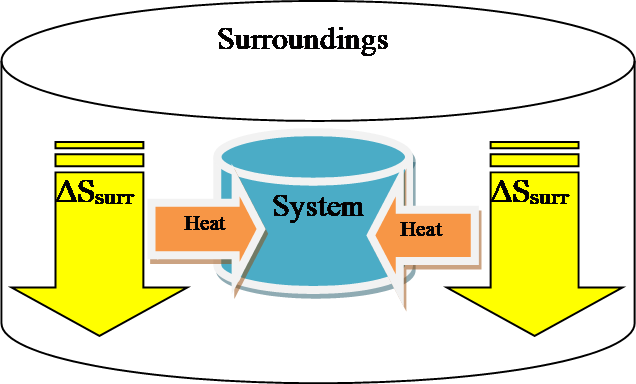
• Entropy change of the surroundings, ΔSsurr
|
I. Gibbs free energy change, ΔG
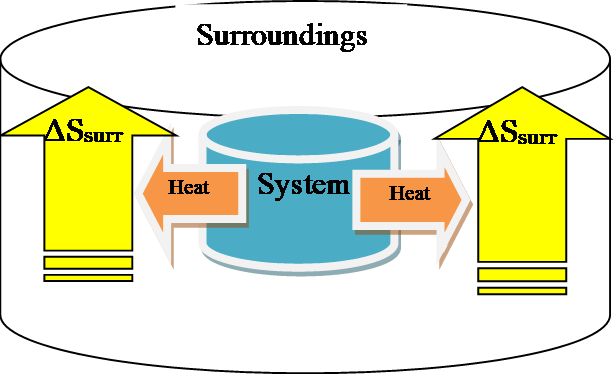
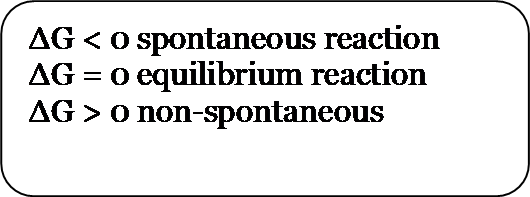
: Determines whether a chemical or physical process is spontaneous or nonspontaneous at constant
temperature and pressure.
|
ΔG = ΔH – TΔS ΔH: enthalpy change T: absolute temperature (K) ΔS: entropy change |
• At T > 0 K, ΔH < 0 and ΔS > 0 give ΔG < 0 at all temperatures.
Qs/ Which of the following represents a spontaneous reaction if T = 1?
A. ΔH = -1, ΔS = -2
B. ΔH = +1, ΔS = -2
C. ΔH = +1, ΔS = +2
D. ΔH = -1, ΔS = +2
E. C and D
ANS: E
Sol/ For ΔG = ΔH – TΔS
A. -1 – (-2) = +1
B. +1 – (-2) = +3
C. +1 – (+2) = -1
D. -1 – (+2) = -3
Qs/ ΔH = 6 and ΔS = 3 at equilibrium. Calculate T.
Sol/ At equilibrium, ΔG = 0. Therefore, ΔH – TΔS = 0.
T = ΔH / ΔS
= 6 / 3
= 2
Energy (E)
1. When 75 J of work is done on the system, ΔE is 100 J. Which of the following is the correct
statement about heat transfer?
A. 25 J of heat is absorbed by the system from its surroundings.
B. 25 J of heat is released by the system to its surroundings.
C. 175 J of heat is absorbed by the system from its surroundings.
D. 175 J of heat is released by the system to its surroundings.
E. There is no heat transfer between the system and its surroundings.