
I. Atom and Ion theory
Key focus of this chapter: atomic structure
This chapter focuses on atomic structure and gives concise summaries of the important things about ion, atomic mass, and nuclear reactions in more detail.
A. Atomic history
|
B. Atomic structure
1. Atom
• An atom is the smallest unit of an element that retains the chemical properties of that element.
• Chemical reactions involve the rearrangement of atoms; atoms are not created or destroyed in ordinary chemical reactions.
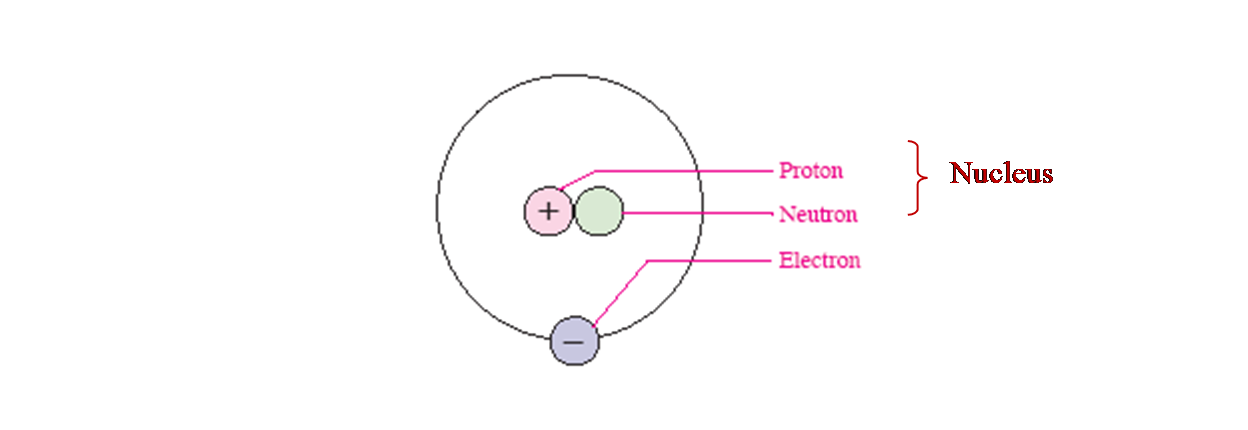
• An atom consists of a nucleus (protons + neutrons) surrounded by electrons.
Fig. 1 Structure of atom
2. Classification of subatomic particles
|
C. Ion
An ion is an atom or group of atoms that has gained or lost one or more electrons and therefore has a net charge.
Cation and anion
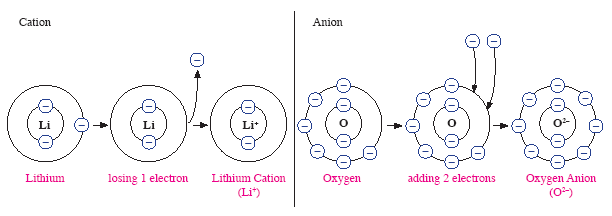
• Cation (+): an atom or ion formed by losing one or more electrons.
• Anion (−): an atom or ion formed by gaining one or more electrons.
Fig. 2 Cation and anion
Isoelectronic species
• Isoelectronic species are different atoms or ions that have the same number of electrons.
• Examples: K⁺ and Ar are isoelectronic; F⁻ and Mg²⁺ are isoelectronic.
3. Isotopes
• Isotopes are atoms of the same element with the same number of protons but different numbers of neutrons, so they have different mass numbers.
• Isotopes of an element have very similar chemical properties but may differ in physical and nuclear properties.
• Radioactive isotopes can be used for radiometric dating of ancient materials and fossil remains.
• Example: hydrogen isotopes—protium (¹H), deuterium (²H), and tritium (³H).
D. Atomic number and mass number

|
E. Nuclear reactions
• Many nuclides are radioactive and spontaneously undergo nuclear decay.
• In an electric field, α particles are deflected toward the negative electrode, β⁻ particles toward the positive electrode, and γ rays are undeflected.
• In a balanced nuclear equation, the sum of the mass numbers (A) is conserved.
• Example: ²¹⁰Po → ²⁰⁶Pb + ⁴He
Mass numbers: 210 = 206 + 4
• The sum of the atomic numbers (Z, proton numbers) is also conserved.
Atomic numbers: 84 = 82 + 2
Fig. 3 Radiation in an electric field

|