
VI. Phases of matter: solid, liquid, and gas
Key focus of this chapter: phase change for water
This chapter focuses on the phase change for water and gives concise summaries of the important things about the phase diagram of H2O and CO2, heating curve of H2O, colligative properties, Raoult’s law, osmotic pressure, and Hery’s law in more detail.
A. Solid, liquid, and gas
|
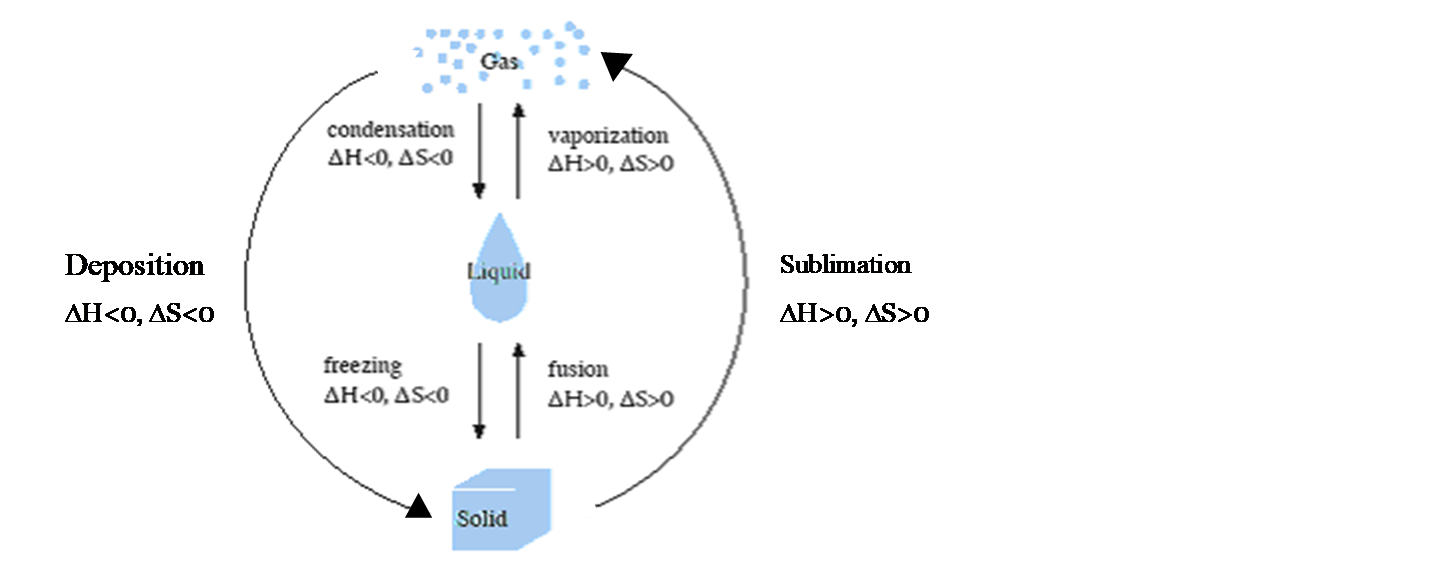
B. Phase change
: A phase change is the conversion of a substance from one physical state to another in response to changes in temperature, pressure, or both.
Fig. 1 Phase change
| ||||||||||||||||||||
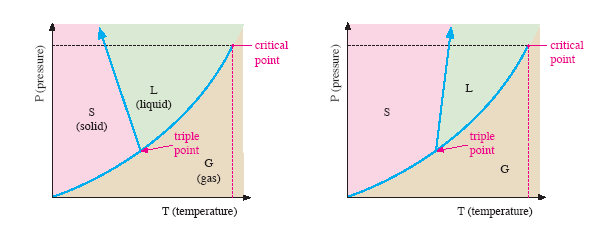
C. Phase diagram of H2O and CO2
Fig. 2 Phase diagram of H2O and CO2

|
• Triple point
- unique temperature and pressure at which solid, liquid, and gas coexist in equilibrium
• Critical point
- endpoint of the liquid–gas coexistence curve
- above the critical temperature, a gas cannot be liquefied by pressure alone
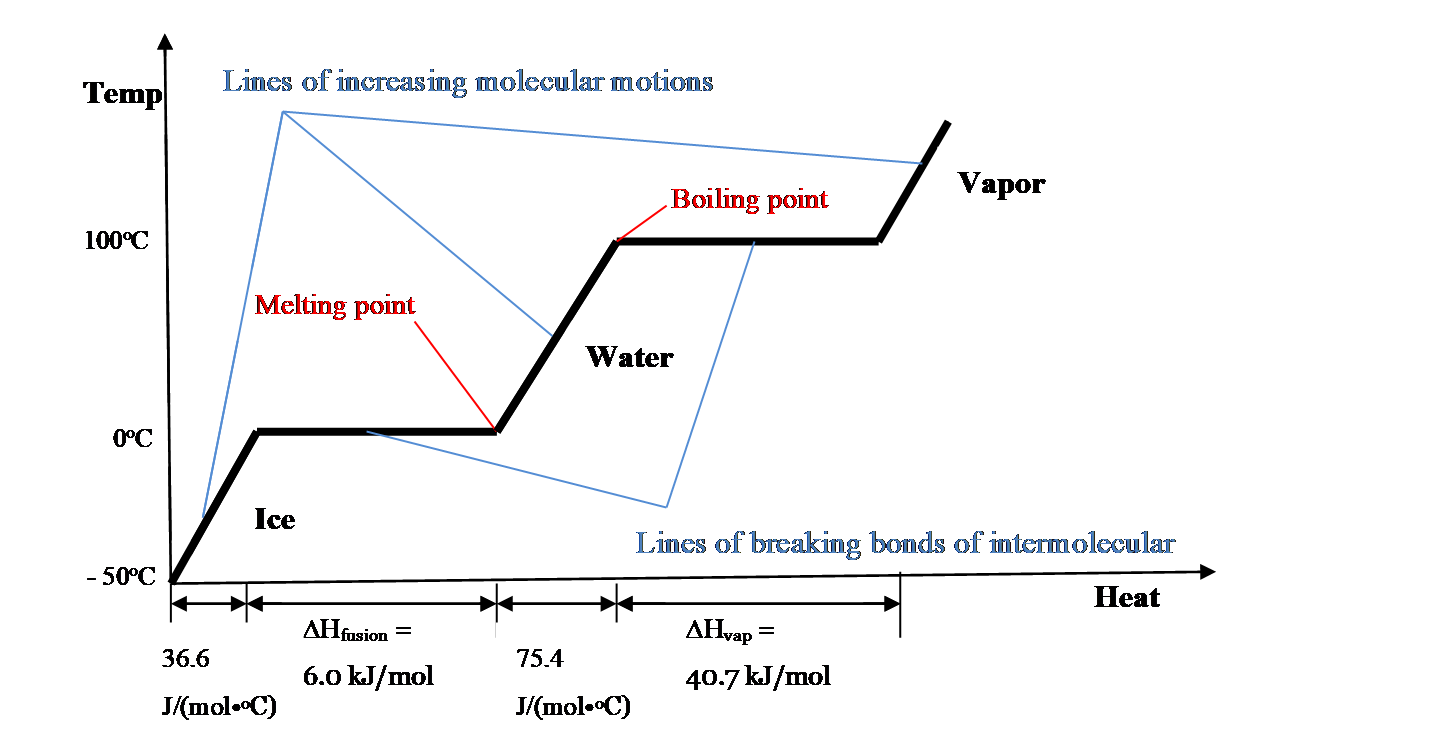
D. Heating curve of H2O
Fig. 3 Heating curve of H2O
|
|
Question: How much energy is required to convert 2.00 mol of ice at −10 °C to liquid water at 50 °C?
Solution: q1 (warming ice) = 36.6 J/(mol·°C)
= 36.6 J/(mol·°C) × 2.00 mol × 10 °C
= 732 J
q2 (melting ice) = ΔHfusion = 6.0 kJ/mol
= 6,000 J/mol × 2.00 mol
= 12,000 J
q3 (warming liquid water) = 75.4 J/(mol·°C)
= 75.4 J/(mol·°C) × 2.00 mol × 50 °C
= 7,540 J
Therefore, qtotal = q1 + q2 + q3 = 732 J + 12,000 J + 7,540 J
= 20,272 J ≈ 20.3 kJ
E. Colligative properties
: Colligative properties depend on the number of dissolved solute particles, not on their chemical identity.
For a nonvolatile solute, the major effects are:
1. Major colligative properties
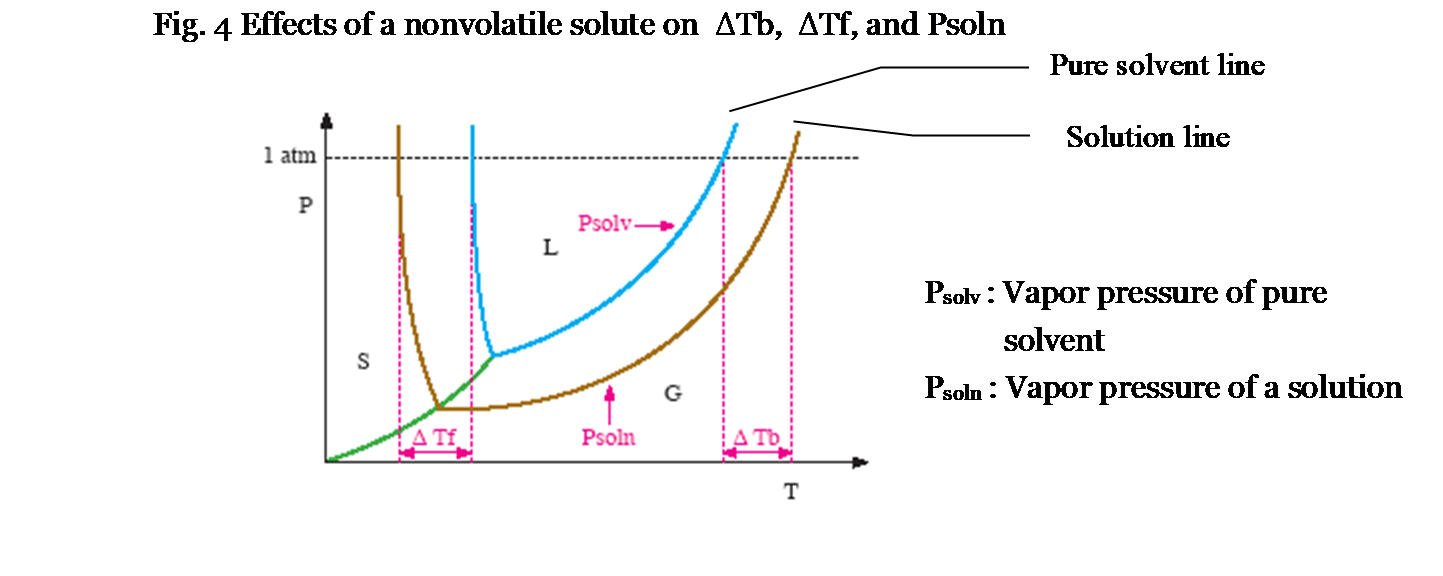
• Vapor-pressure lowering and boiling-point elevation
• Freezing-point depression
• Osmotic pressure
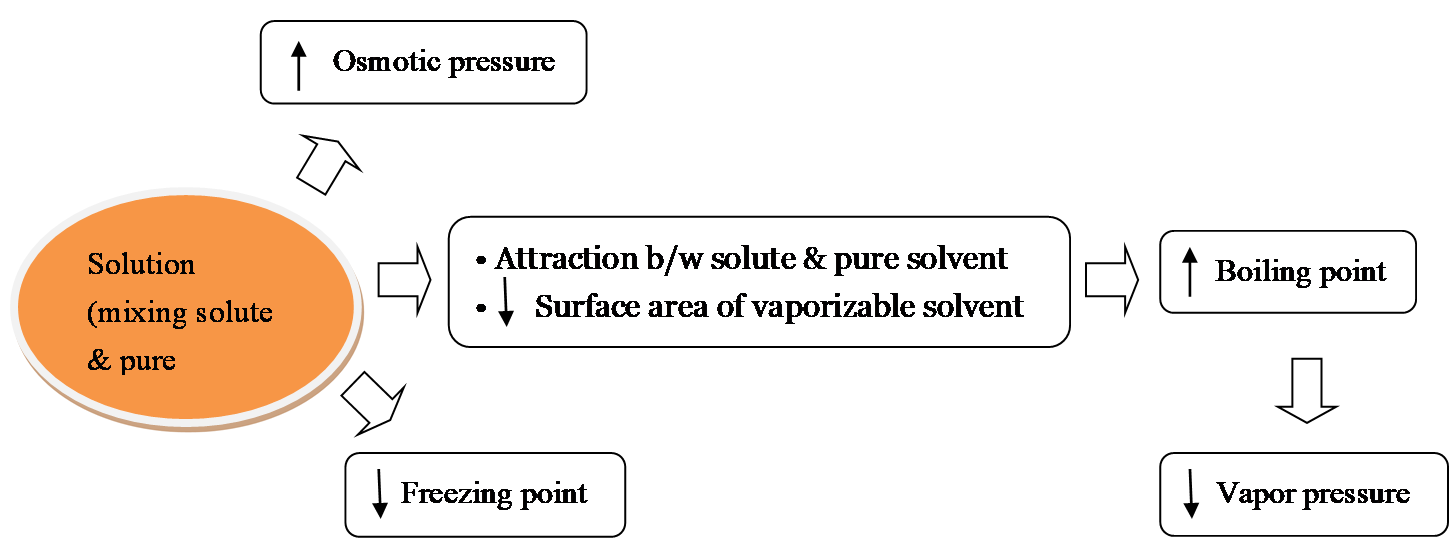
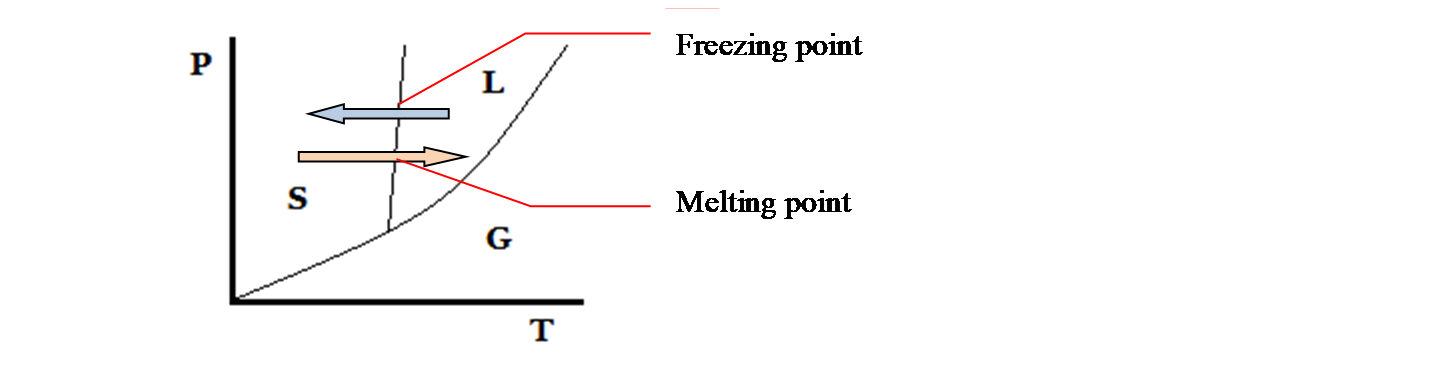
A solution containing a dissolved solute generally freezes at a lower temperature than the pure solvent.
See Fig. 4.
2. Boiling-point elevation and freezing-point depression
|
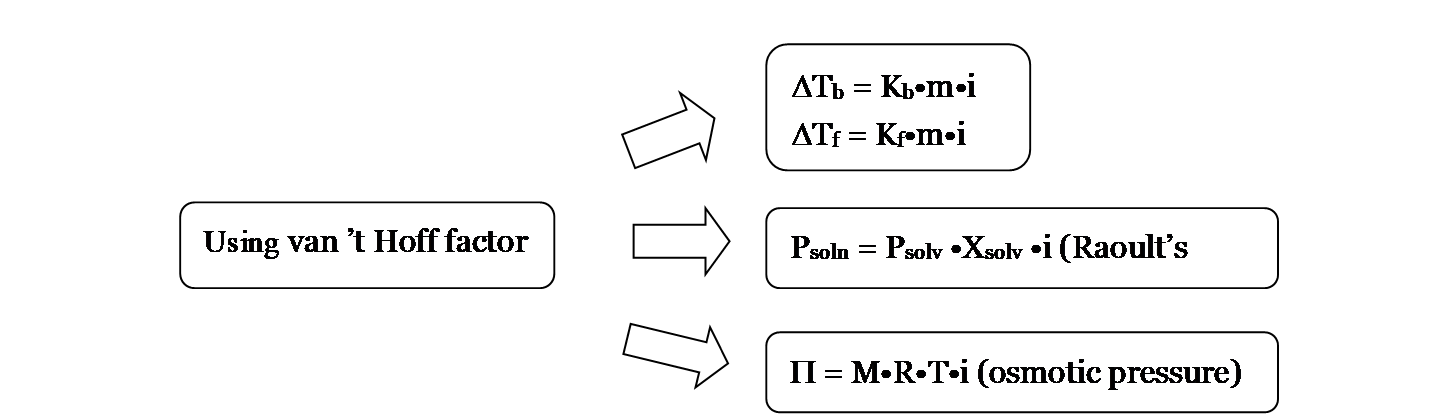
van ’t Hoff factor, i: effective dissolved particles per formula unit (ideal limit)
• CH3OH: nonelectrolyte; i ≈ 1
LiCl → Li⁺ + Cl⁻; i ≈ 2
CaCl2 → Ca²⁺ + 2Cl⁻; i ≈ 3
Question: Calculate the freezing point of 21.0 g LiCl in 1.000 kg water. Assume ideal complete dissociation; Kf = 1.86 °C·kg/mol.
ΔTf = iKfm
Molar mass of LiCl = 6.94 + 35.45 = 42.39 g/mol
Moles of LiCl = 21.0 g/(42.39 g/mol) = 0.495 mol
Molality, m = 0.495 mol/1.000 kg H2O = 0.495 mol/kg
For ideal complete dissociation, i ≈ 2 (LiCl → Li⁺ + Cl⁻).
ΔTf = (1.86 °C·kg/mol)(0.495 mol/kg)(2) = 1.84 °C
Freezing point = 0.00 °C − 1.84 °C = −1.84 °C
F. Raoult’s law
: For an ideal solution, the partial pressure of a volatile component equals its mole fraction in the solution
multiplied by the vapor pressure of the pure component.
|
Derived form of Raoult’s law
Psoln × total moles in solution = P°solv × moles of solvent
Psoln = P°solv × (moles of solvent/total moles in solution)
Psoln = P°solv × Xsolv
• A nonvolatile solute lowers the solvent mole fraction, so the solution’s vapor pressure is lower
than that of the pure solvent.
Fig. 5 Vapor pressure of a pure solvent and a solution
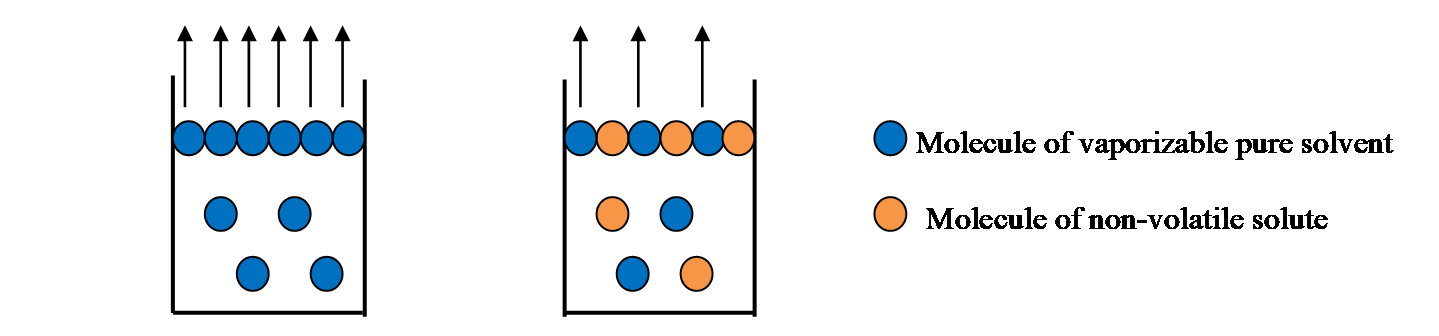
Pure solvent Solution (solvent + nonvolatile solute)
See Fig. 4 for the effects on P°solv and Psoln.
Question: Calculate the vapor pressure when 4.0 mol K2SO4 is dissolved in 12.0 mol H2O at 45 °C.
Assume ideal behavior and complete dissociation; P°H2O = 70 mmHg.
Psoln = P°solv × Xsolv
P°solv = 70 mmHg
Xsolv = nsolvent/(nsolvent + i·nsolute)
= 12/(12 + 3 × 4)
= 0.50
For ideal complete dissociation, i ≈ 3 (K2SO4 → 2K⁺ + SO4²⁻).
Therefore, the vapor pressure of the solution is:
Psoln = P°solv × Xsolv
= 70 mmHg × 0.50
= 35.0 mmHg
G. Osmotic pressure (P)
: Osmotic pressure is the external pressure required to stop the net flow of solvent into a solution
through a semipermeable membrane.
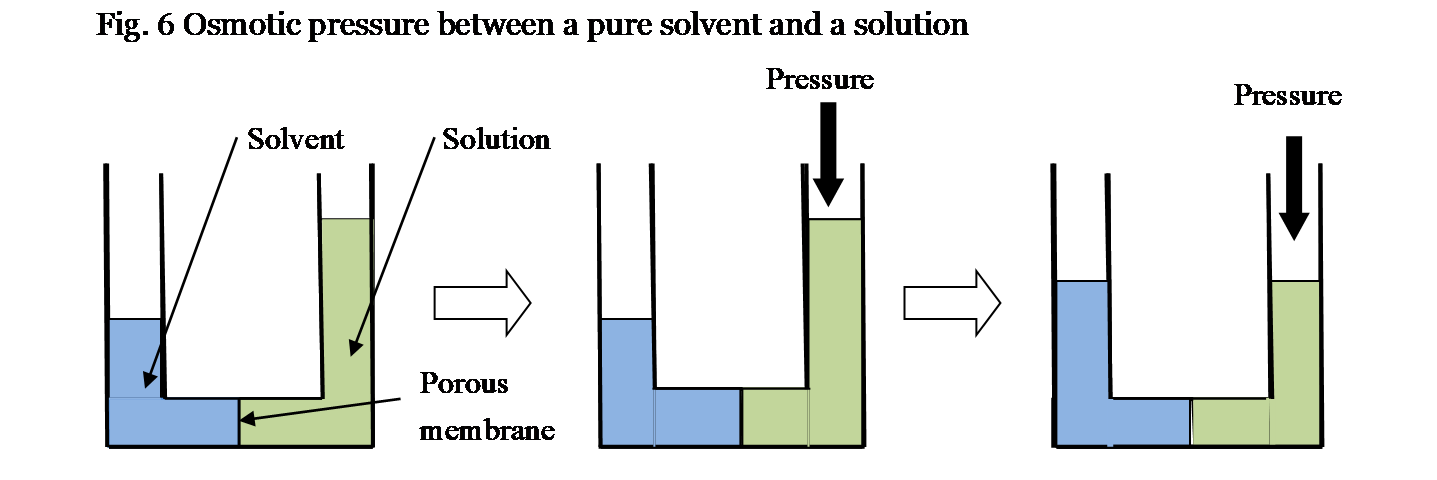
Osmosis: net movement of solvent through a semipermeable membrane from lower solute concentration to higher solute concentration.
|
Relation to the ideal gas law
PV = nRT → P = (n/V)RT = MRT; for dissolved particles, Π = iMRT
Question: 116 g NaCl is dissolved to make 4.00 L of solution at 27 °C. Calculate the osmotic pressure.
Molar mass of NaCl = 22.99 + 35.45 = 58.44 g/mol
Moles of NaCl = 116 g/(58.44 g/mol) = 1.985 mol
Molarity of NaCl = 1.985 mol/4.00 L = 0.496 M
R = 0.08206 L·atm/(mol·K)
T = 273.15 + 27 = 300.15 K
For ideal complete dissociation, i ≈ 2 (NaCl → Na⁺ + Cl⁻).
Π = iMRT
= (2)(0.496 mol/L)(0.08206 L·atm/(mol·K))(300.15 K)
= 24.4 atm
H. Henry’s law
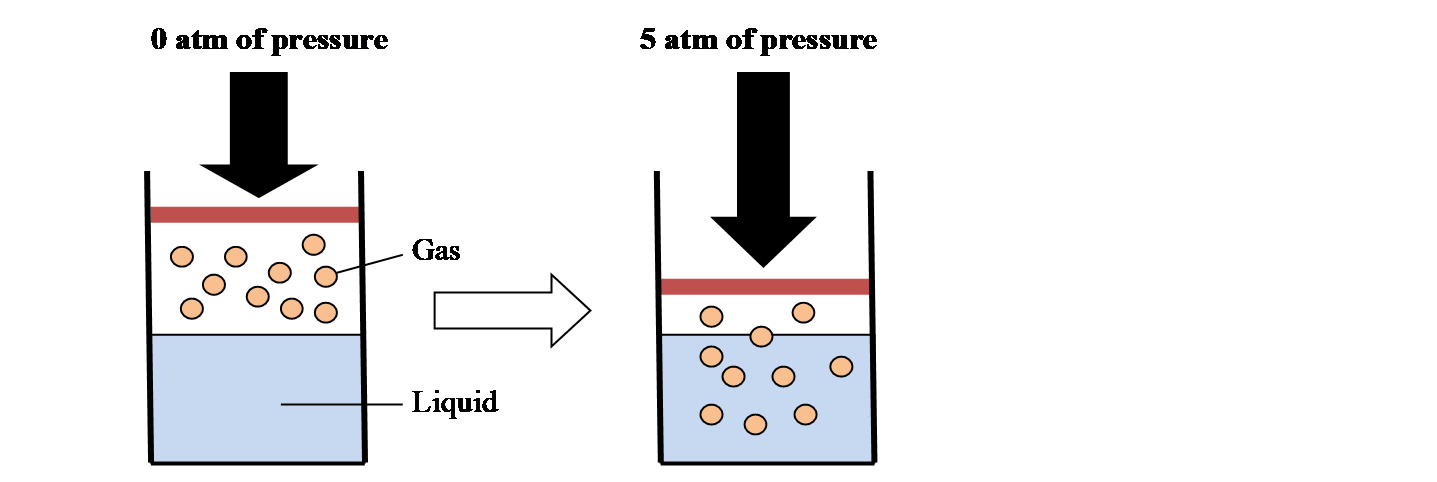
: At constant temperature, dissolved-gas concentration is proportional to the gas’s partial pressure above the solution.
Fig. 7 Gas solubility as a function of partial pressure
|


Question: Find the gas solubility at 23 °C when Pgas = 3.0 atm and
k = 5.0 × 10⁻² mol/(L·atm).
Cgas = kP
= (5.0 × 10⁻² mol/(L·atm))(3.0 atm)
= 0.15 mol/L