
III. Ecology
Key focus of this chapter: population and communities.
This chapter focuses on population and communities and gives concise summaries of the important things about ecosystem and biosphere.
A. Hierarchical levels of organization

|
B. Species
1. Historic biologists
a. Aristotle (384 – 322 B.C.)
• Scala naturae (“scale of nature”) – a historical hierarchy that ranked organisms from simpler to more complex forms.
• Aristotle considered species fixed and unchanging; this is a historical view, not modern evolutionary biology.
b. Carolus Linnaeus (1707 – 1778)
• Binomial nomenclature – two-part scientific names (genus and species).
• Linnaeus classified organisms by shared traits and initially regarded species as fixed; modern taxonomy also uses evolutionary relationships.
c. Georges Cuvier (1769 – 1832)
• Paleontology – the study of fossils
• Catastrophism – sudden geological events can cause extinctions and help explain changes seen among fossil-bearing rock strata.
d. James Hutton (1726 – 1797)
• Gradualism – major geological change can result from the slow accumulation of small, continuous processes.
e. Charles Lyell (1797 – 1875)
• Uniformitarianism – geological processes operating today also operated in the past over long periods of time.
f. Jean Lamarck (1744 – 1829)
• Inheritance of acquired characteristics – Lamarck’s historical hypothesis that acquired traits could be inherited.
• Use and disuse were central to Lamarck’s model; this is not accepted as the general mechanism of evolutionary adaptation.
g. Charles Darwin (1809 – 1882)
• Voyage of HMS Beagle; observations from the Galápagos Islands contributed to Darwin’s ideas about evolution.
- Reproductive isolation is a key mechanism in speciation, but Darwin’s observations were not the first experimental proof of a new species.
• On the Origin of Species
- Descent with modification from common ancestors
- Natural selection is a major mechanism of adaptive evolution
• Natural selection
- Individuals with heritable traits that increase reproductive success tend to contribute more offspring to the next generation.
• Artificial selection
- Selective breeding by humans increases the frequency of chosen heritable traits.
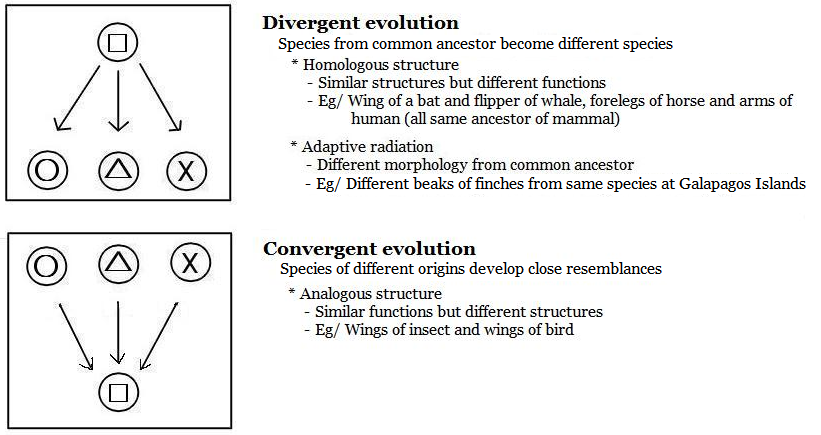
2. Evolution and structure
• Evolution: a change in allele frequencies in a population across generations.
Fig. 1 Divergent and convergent evolution
3. Geographic separation
• Allopatric speciation
- New species arise after geographic isolation reduces gene flow between populations.
• Sympatric speciation
- New species arise without a geographic barrier, often through reproductive isolation within the same area.
- Populations initially occupy the same geographic region.
C. Population
1. Variation of evolution
a. Mutation – the ultimate source of new alleles and new genetic variation.
b. Sexual recombination – reshuffles existing alleles into new genotype combinations.
2. Alteration of genetic composition
a. Genetic drift
Random changes in allele frequencies, especially strong in small populations; drift can reduce genetic variation.
• Bottleneck effect
- A sudden reduction in population size can leave a nonrepresentative sample of the original gene pool.
• Founder effect
- A new population founded by a few individuals may have allele frequencies different from the source population.
b. Gene flow
- Movement of alleles into or out of a population through migration of individuals or gametes.
c. Natural selection
Primary mechanism of adaptive evolution.
• Geographic variation / cline
- A cline is a gradual geographic change in phenotype or allele frequency across an environmental gradient.
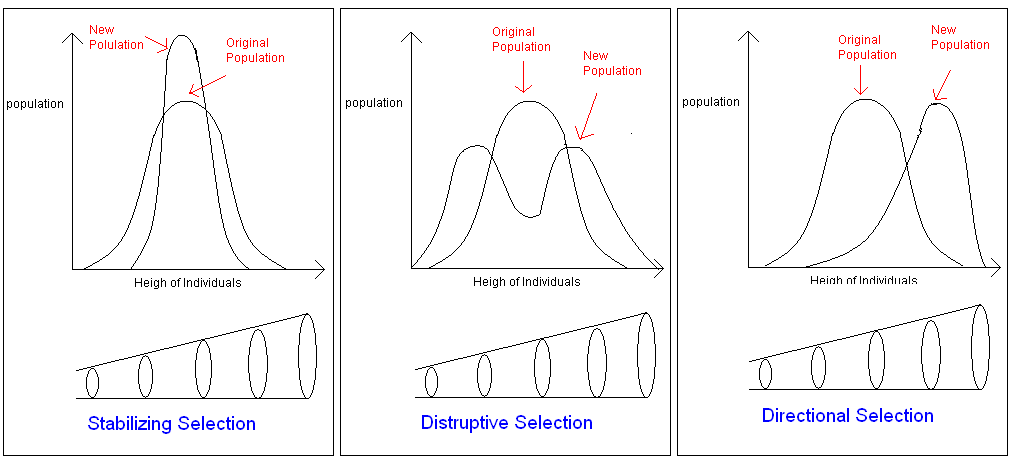
• Evolutionary fitness
- Directional selection: favors one extreme phenotype, shifting the population distribution toward that extreme.
- Disruptive (diversifying) selection: favors both extreme phenotypes over intermediate phenotypes.
- Stabilizing selection: favors intermediate phenotypes and selects against extremes.
Fig. 2
3. Population dynamics
a. Exponential growth
• Population grows at an approximately constant per-capita rate when resources are abundant (J-shaped curve).
• Growth occurs when additions to the population exceed losses.
b. Logistic growth
• Sigmoid (S-shaped) growth curve.
• Growth is rapid at low density but slows as density-dependent limits increase near carrying capacity.
• Carrying capacity (K): the population size an environment can sustain over time under given conditions.
• Life histories
|
D. Community ecology
1. Niche and habitat
• Niche: a species’ ecological role and the range of resources and environmental conditions it uses.
• Habitat: the physical environment or place where an organism lives.
2. Species interactions
|
3. Defensive adaptation
Defensive adaptations that reduce predation or herbivory.
|
4. Innate and learned behaviors
a. Fixed action pattern (FAP)
• An innate, stereotyped sequence of behavior triggered by a specific sign stimulus.
• E.g., egg-rolling behavior in greylag geese or stereotyped courtship displays.
b. Imprinting
• Rapid learning during a sensitive period early in life.
• Combines an innate predisposition with experience-dependent learning.
• Young animals learn a particular stimulus or individual, which can influence later social or reproductive behavior.
• E.g., young geese following a parent; conservation programs have used surrogate leaders for imprinted cranes.
c. Habituation
• Decreased response to a repeated, harmless stimulus.
• E.g., an animal gradually stops responding to a repeatedly presented harmless sound.
d. Spatial learning
• Learning and remembering spatial relationships, landmarks, routes, or locations.
e. Associative learning
Learning that forms an association between two stimuli or between a behavior and its consequence.
|
f. Extinction
• Extinction: a conditioned response weakens when the conditioned stimulus is repeatedly presented without the unconditioned stimulus; operant behavior can also weaken when reinforcement stops.
5. Ecological succession
Ecological succession is the sequential change in community composition and structure over time, often after new substrate forms or a disturbance occurs.
a. Primary succession
• Begins on newly exposed
substrate where soil is absent.
• Examples: fresh lava or land exposed by a retreating glacier.
• Pioneer organisms often include microbes, lichens, algae, and mosses that help build soil and alter the environment.
• Communities
|
b. Secondary succession
• Begins after a disturbance where soil and some biological legacies remain.
• Examples include areas recovering after fire, storms, logging, or abandonment of farmland.
E. Ecosystem
1. Biotic and Abiotic factors
• Biotic factors: living organisms and their interactions within an ecosystem.
• Abiotic factors
- Nonliving physical and chemical components of the environment.
- E.g., water, temperature, sunlight, wind, pH, and nutrients.
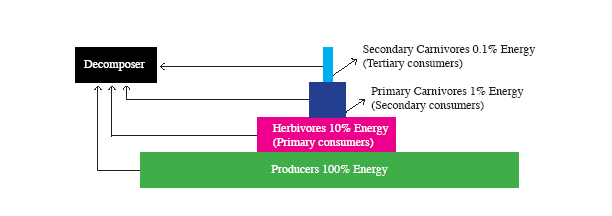
2. Energy flow in ecosystem
a. Food chain
• Biomagnification: persistent toxins can become more concentrated at successively higher trophic levels.
|
Fig. 3
3. Nutrient cycles
Biogeochemical cycles move water and chemical elements between biotic and abiotic reservoirs.
a. Water cycle
• Essential to all living organisms
• Evaporation and transpiration -> condensation -> precipitation -> runoff, infiltration, and return to surface waters.
b. Phosphorus cycle
• Phosphorus is a component of ATP, nucleic acids, and phospholipids.
• Weathering releases phosphate -> plant uptake -> consumers -> decomposition and return to soil/water; sedimentation provides long-term storage.
c. Carbon cycle
• Carbon forms the backbone of organic molecules in living organisms.
• Photosynthesis removes CO2 from air or water; respiration, decomposition, and combustion return CO2 to the environment.
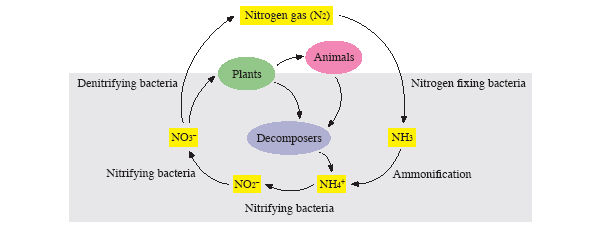
d. Nitrogen cycle
• Nitrogen is required for amino acids, proteins, nucleic acids, and other biomolecules.
• N2 -> nitrogen fixation -> NH3/NH4+ -> nitrification -> NO2- -> NO3-; assimilation incorporates inorganic nitrogen into biomass, and denitrification returns N2 to the atmosphere.
|
Fig. 4 Nitrogen cycles
4. Temperature and osmoregulation
a. Climate
• Microclimate
- Local atmospheric conditions near the ground or around organisms that can differ from the broader regional climate.
- Can strongly affect individual organisms and local populations.
• Macroclimate
- Broad regional or global climate patterns.
- Strongly influences the geographic distribution of species and biomes.
b. Thermoregulation
• Endotherms
- Generate substantial metabolic heat and can maintain body temperature within a relatively narrow range.
- E.g., most mammals and birds. “Warm-blooded” is an informal term.
• Ectotherms
- Rely mainly on external heat sources; body temperature often varies with environmental conditions.
- E.g., most reptiles, amphibians, fishes, and invertebrates. “Cold-blooded” is an informal and often misleading term.
5. Osmoregulation in bony fish
a. Freshwater fish
• Freshwater bony fish are hyperosmotic to the environment: water enters by osmosis, they drink little, excrete copious dilute urine, and actively take up ions across the gills.
b. Saltwater fish
• Marine bony fish are hypoosmotic to seawater: they lose water by osmosis, drink seawater, excrete excess salts through the gills, and produce relatively little urine.
F. Biosphere
1. Aquatic zones
a. Lake zones
|
b. Marine zones
| |||||||||||||||||||||
2. Climate and lake mixing
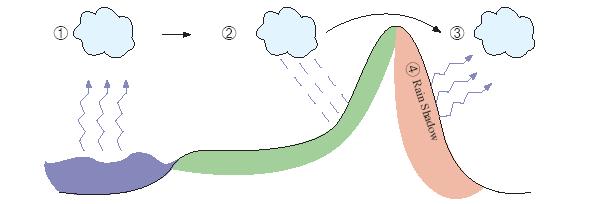
a. Rain shadow
• Moist air rises on the windward side of a mountain, expands and cools, causing condensation and precipitation.
• Drier air descends on the leeward side, compresses and warms, lowering relative humidity and creating a rain-shadow region.
• Eg/ Death Valley (Sierra Nevada)
Fig. 5 Rain shadow
b. Seasonal lake turnover
In many temperate dimictic lakes, spring and fall turnover mix oxygen-rich surface water with nutrient-rich deeper water.
• Turnover occurs when temperature and density differences weaken enough for wind-driven mixing of the water column.
• Spring turnover
- Surface water warms toward about 4°C, approaches the density of deeper water, and the lake mixes.
• Fall turnover
- Surface water cools toward about 4°C, becomes denser, and wind-driven mixing circulates the lake.
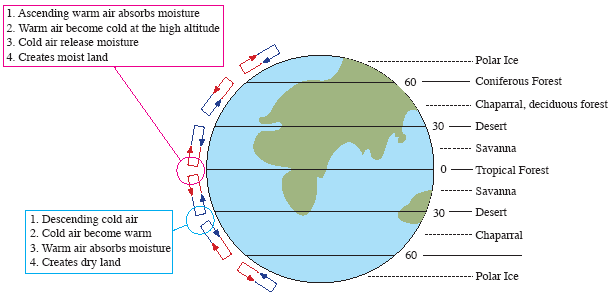
3. Terrestrial biomes
Fig. 6
|
1. Which of the following is NOT a factor that influences regional climate?
A. Ocean currents
B. Altitude
C. Latitude
D. Atmospheric circulation
E. None of above
2. In a community, when two species benefit each other, it is called __________ .
A. Mutualism
B. Commensalism
C. Competition
D. Parasitism
E. Predation