IV. Bacteriology
Key focus of this chapter: bacteria vs virus.
This chapter compares bacteria and viruses and reviews animal viruses and bacteriophages.
A. Prions
- Composed of infectious proteins.
- Misfolded prion protein (PrPSc) promotes misfolding of normal prion protein and causes neurodegeneration in mammals.
- Scrapie disease in sheep, Mad cow disease (BSE), and Creutzfeldt-Jakob disease (CJD) in humans.
B. Viroids
- Composed of circular and single stranded RNA molecules without protein capsid.
- Plant pathogens.
C. Virus
: infectious agent that needs a host cell to reproduce.
- Composed of DNA or RNA molecules and protected by protein coat.
- Lacks organelles and cell wall.
- Host range depends on compatible host receptors and intracellular factors.
- Impossible to reproduce without host cell.
- Acellular; generally not classified as living organisms.
1. Viral types
Classification | Shapes | Features |
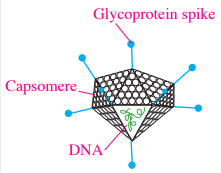
Adenoviruses | ![]() | • Naked virus • Double stranded DNA • Capsomere of polyhedral capsid with glycoprotein spike • Infects respiratory tracts |
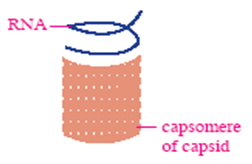
Tobacco mosaic virus | ![]() | • Naked helical virus • Single stranded RNA Virus • Capsomere of helical capsid with rod shape • Infects tobacco plant |
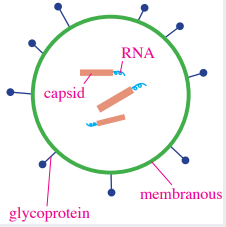
Influenza viruses | ![]() | • Enveloped virus • Single stranded RNA Virus • Membranous envelope with glycoprotein • RNA molecules wrapped in helical capsid |
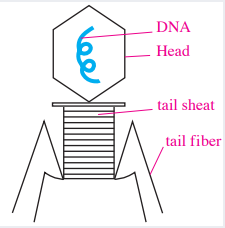
Bacteriophage T4 | ![]() | • DNA virus • Polyhedral head, tail sheath, and tail fiber • Infects E. coli • Only lytic phase |
2. Reproductive cycle of virus
a. Animal virus

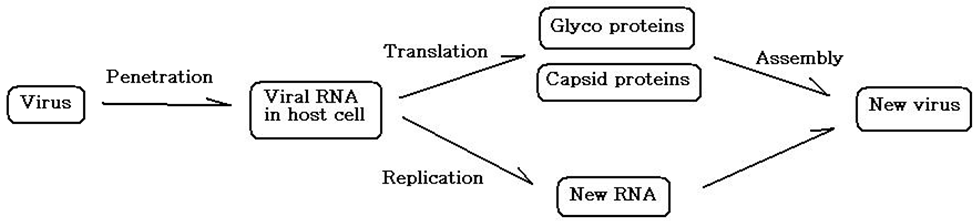
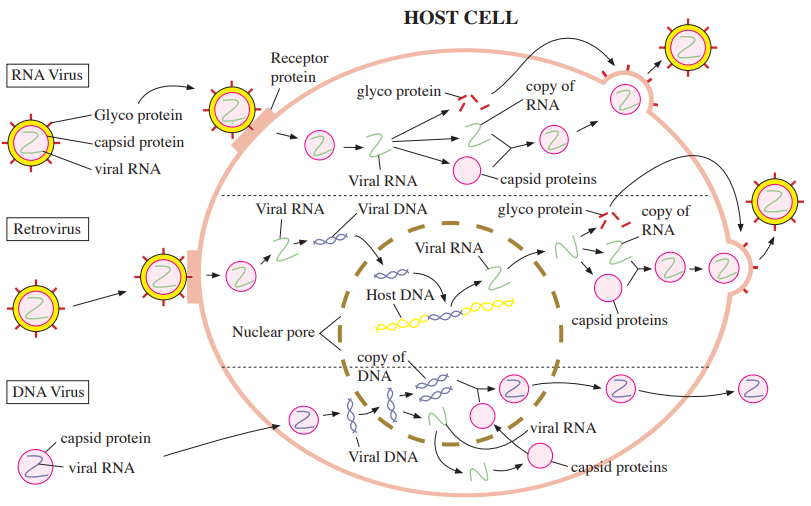
- RNA virus
– synthesizes new genomes from viral RNA.
– eg/ Influenza virus, hepatitis C, SARS

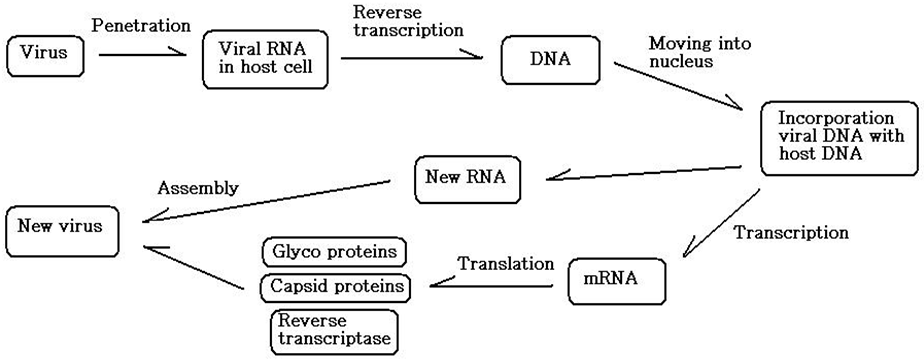
- Retrovirus
– reverse transcriptase (synthesizing DNA from RNA).
– viral DNA integrates into host DNA as a provirus; host transcription produces viral RNA.
– RNA → DNA → integrated provirus → RNA.
– eg/ HIV (causes AIDS), some tumor-associated retroviruses
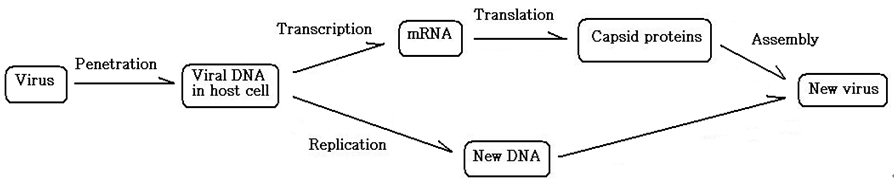
- DNA virus
– synthesizes new genomes from viral DNA.
– eg/ Adenovirus, herpesvirus, papillomaviruses and polyomaviruses
b. Bacteriophage
- Infect bacteria
- Some have complex head–tail structures
- Transduction: phage-mediated transfer of bacterial DNA
- Bacteriophage T4
– composed of polyhedral head, tail sheath, and tail fiber
– virulent phage
– only lytic cycle
- Bacteriophage lambda (λ)
– temperate phage (both lytic cycle and lysogenic cycle)
– infects Escherichia coli bacteria
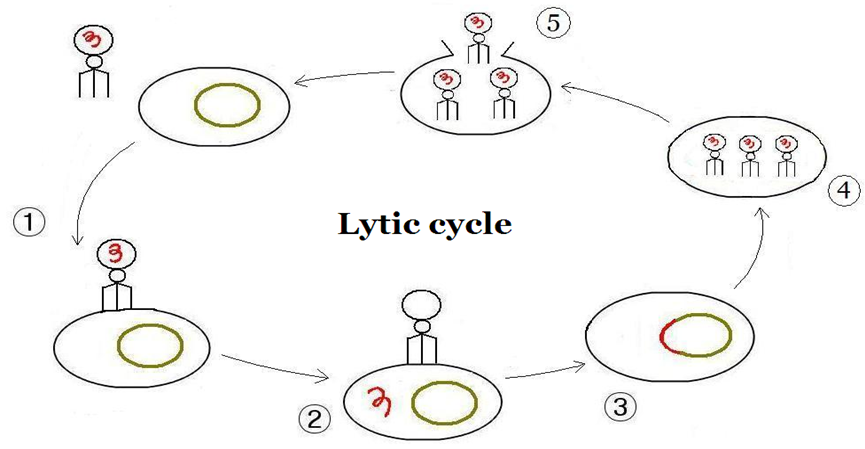
- Lytic cycle
: phage replication followed by host-cell lysis; virulent phages use this cycle.
– ① approaching and attachment.
– ② entry of phage DNA.
– ③ Phage DNA replicates, and viral components are synthesized.
– ④ New phages are assembled.
– ⑤ host-cell lysis releases new phages.

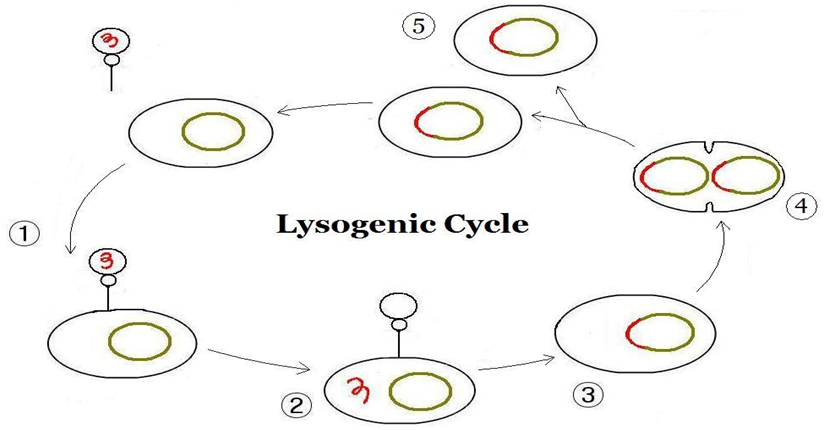
- Lysogenic cycle
: in temperate phages, a prophage is maintained and copied with the host genome; induction can switch it to the lytic cycle.
– ① approaching and attachment
– ② entry of phage DNA
– ③ integration of phage DNA as a prophage
– ④ copying prophage
– ⑤ bacterial cell division passes the prophage to daughter cells

** Comparison of animal virus and bacteriophage multiplication
Stage of reproduction | Animal Virus | Bacteriophage |
Attachment | • Viral surface proteins bind host-cell receptors | • In tailed phages, tail fibers bind bacterial surface receptors |
Penetration | • Enveloped viruses enter by membrane fusion or endocytosis • Nonenveloped viruses enter by endocytosis or other penetration mechanisms | • Nucleic acid into host cell |
Synthesis and Assembly | • Location varies by virus: cytoplasm and/or nucleus | • At cytoplasm only |
D. Bacteria
1. Shapes
- Bacilli – rod shaped
- Cocci – spherical
- Spiral – helical
** Arrangement of prefixes
- Diplo (pair), staphylo (clusters), strepto (chains)
- Eg/ Staphylococci (spherical clusters)
2. Cell-surface Structures
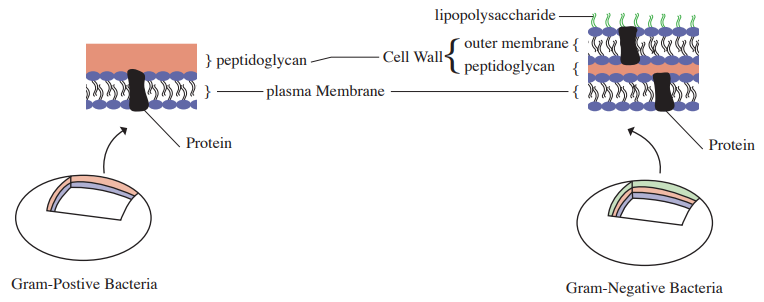
- Gram-positive
– cell wall with thick sheet of peptidoglycan (network composed of modified sugar and amino acids).
- Gram-negative
– cell wall with outer membrane and thin sheet of peptidoglycan.
– outer membrane containing lipopolysaccharide.
3. Motility
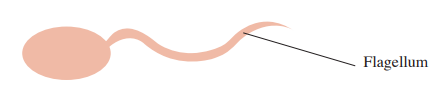
- Bacterial flagella rotate using energy from an ion gradient across the membrane, usually the proton motive force. Some bacteria use a Na⁺ gradient instead.
- Flagellum made of basal apparatus, hook, and filament.
- Bacterial flagella are not membrane-enclosed extensions of the cell.
- Taxis – Directed movement toward or away from a stimulus.
4. Genetic recombination
: horizontal gene transfer increases bacterial genetic diversity; it is distinct from reproduction.
- Transduction
– DNA transfer between bacteria mediated by bacteriophages.
- Transformation
– uptake of free extracellular DNA, which may alter genotype and phenotype.
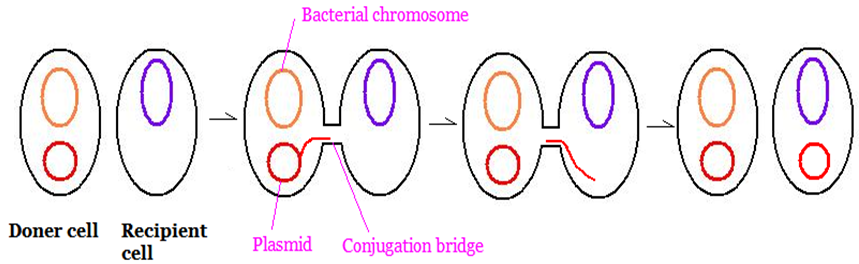
- Conjugation
– DNA transfer through direct cell contact; a sex pilus can initiate mating-pair formation.
– genetic exchange without gametes or fusion of cells.
– plasmid: Usually circular, independently replicating DNA separate from the bacterial chromosome; some plasmids mediate horizontal gene transfer.
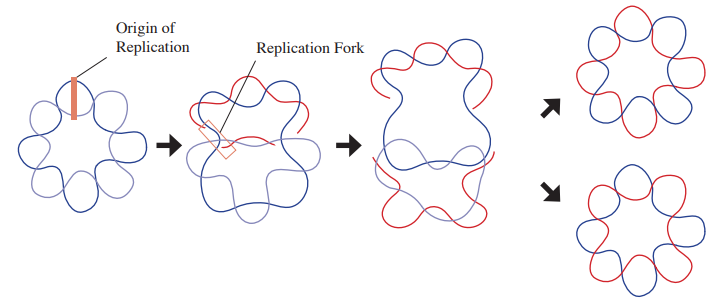
5. Binary fission
: asexual cell division that produces two daughter cells.
- Chromosome replication
– starting point of replication in both directions.
– bi-directional progress
6. Gene expression
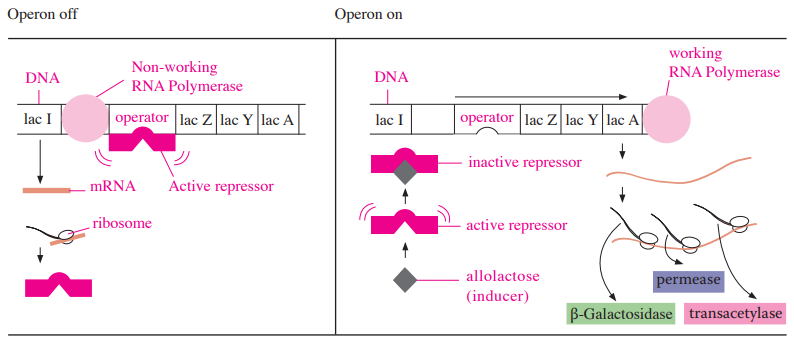
- Lac operon (inducible system)
– controls lactose uptake and metabolism in E. coli; lactose is hydrolyzed to glucose and galactose.
– operon off: Without inducer, the repressor binds the operator and inhibits transcription of lac genes.
– operon on: Allolactose binds the repressor, reducing operator binding and permitting transcription; translation yields β-galactosidase, permease, and transacetylase. Strong expression also requires low glucose (cAMP–CAP activation).
Enzymes | Functions |
β-Galactosidase | • Made from lacZ • Hydrolyzing lactose to glucose and galactose |
Permease | • Made from lacY • Moving lactose into cell |
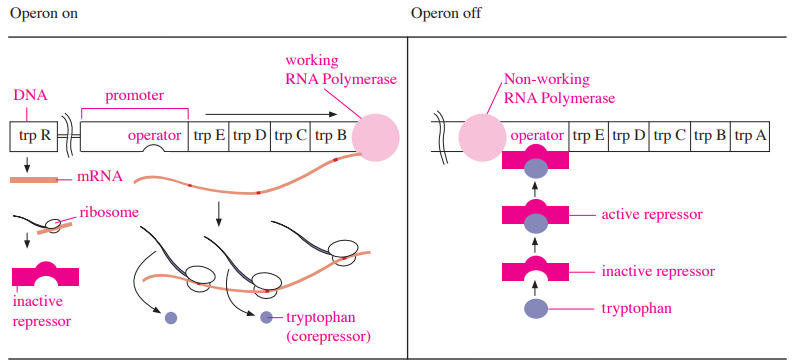
- Trp operon (repressible system)
– controls enzymes for tryptophan synthesis in E. coli.
– operon on: When tryptophan is low, the repressor is inactive and transcription permits production of tryptophan-synthesis enzymes.
– operon off: Tryptophan acts as a corepressor: binding activates the repressor, which binds the operator and inhibits transcription.
7. Metabolic adaptation
- Oxygen relationship
Classification | Features |
Obligate aerobes | • Aerobic organisms that need O2 for cellular respiration • Without O2 aerobic organisms cannot grow |
Obligate anaerobes | • Anaerobic organisms that cannot grow with O2 |
Facultative anaerobes | • Use aerobic respiration when oxygen is available; without it, use fermentation or anaerobic respiration. • Eg/ E.coli |
- Biofilms
– a microbial community attached to a surface and embedded in a self-produced extracellular matrix.
8. Bacterial pathogens and diseases
Bacterial pathogens | Diseases |
Borrelia burgdorferi and related species | • Lyme disease |
Salmonella enterica serovar Typhi | • Typhoid fever |
Escherichia coli (pathogenic strains) | • Diarrhea, sepsis, urinary tract infection |
Neisseria gonorrhoeae / N. meningitidis | • Gonorrhea and meningitis |
Toxigenic Corynebacterium diphtheriae | • Diphtheria |
Clostridium tetani / C. perfringens | • Tetanus, gas gangrene |
Streptococcus pneumoniae | • Pneumonia |
E. Benefits of microbe
- Some intestinal bacteria synthesize vitamin K; their contribution to human vitamin K supply varies.
- Breakdown of organic materials and recycling of nutrients.